Charging time can directly affect how a battery-powered machine fits into a contractor’s daily workflow. Before ordering an electric scissor lift, buyers should ask more than how long the battery lasts. Charger output, battery capacity, charging conditions, shift patterns, available power, and planned utilization all influence whether the machine can return to service when needed.
Ask for Battery Capacity and Charger Output
The first two figures to request are battery capacity and charger rating. Battery capacity is commonly given in amp-hours (Ah), while charger output is expressed in amperes (A). A simple capacity-to-current calculation can provide a theoretical charging duration, but it should not be treated as the guaranteed time for a complete charge.
For example, a 135 Ah battery paired with a 30 A charger gives a basic calculation of 4.5 hours. Actual charging can differ because charging efficiency, battery condition, temperature, and the final charging stage all affect the process.
Ask What “Full Charge” Means
Buyers should clarify whether a supplier’s stated charging figure means reaching a specific battery level or completing a full charge. These are not necessarily the same operating condition.
Also ask whether charging time is measured from fully depleted or from a normal working level. A machine that returns to the charging point with significant energy remaining may require much less time than the theoretical full-charge calculation.
Match Charging With the Work Shift
Charging requirements should be compared with the contractor’s daily schedule. A single-shift operation may have several hours available for overnight charging, while a multi-shift project may require opportunities during breaks or between work periods.
For an electric scissor lift, buyers should calculate expected operating hours rather than assuming that a full workday equals continuous lifting and driving. Actual energy use varies with travel, lifting frequency, load, surface conditions, and jobsite layout.
Check the Available Power Supply
A charger cannot deliver its rated output without a suitable electrical supply. Before purchasing, confirm the required input voltage, frequency, connection type, and available site power.
This is particularly important for projects where machines are charged inside commercial buildings or temporary construction facilities. Buyers should verify whether the existing electrical infrastructure can support charging without creating conflicts with other equipment.
Ask About Charging Conditions
Battery charging should take place in an appropriate environment. Buyers should ask about permitted temperature ranges, ventilation, weather exposure, and whether the battery compartment or charger requires specific operating conditions.
Manufacturer instructions should take priority over assumptions based on automotive or consumer batteries. Zoomlion’s operation and safety guidance, for example, instructs users to use the authorized charger, supply the proper AC input voltage, and charge batteries in a well-ventilated area.
Consider a slim scissor lift for Indoor Charging Areas
Physical dimensions can influence where equipment can be parked and charged. A slim scissor lift may be easier to position in narrow service areas, corridors, storage zones, or other locations with restricted floor space.
However, compact width should not be evaluated separately from battery and charger specifications. Buyers should consider machine dimensions, charging access, travel routes, doorways, and available electrical connections together when planning the charging location.
Ask How Charging Affects Utilization
A quotation should be evaluated against utilization requirements, not charging time in isolation. Buyers can estimate the number of lifts, travel movements, and operating periods expected during a typical shift, then identify when charging can occur.
It is also useful to establish a charging routine before delivery. Assigning charging locations and responsibilities can reduce situations where equipment is parked without being connected or returned to service without sufficient battery energy.
Review the ZS0607AC-Li Specifications
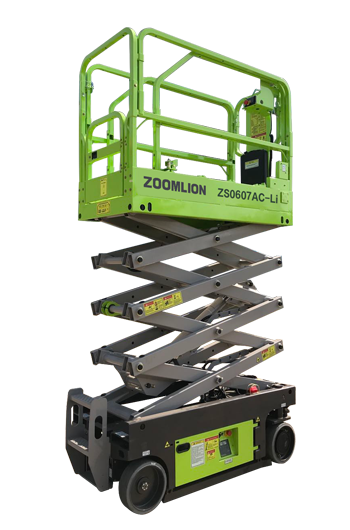
For buyers considering a compact battery-powered option, Zoomlion Access lists the ZS0607AC-Li with a 7.8 m maximum indoor working height and 6.4 m maximum outdoor working height. Their official specification chart lists a 135 Ah lithium-ion battery and a 24 V/30 A charger. The platform capacity is 230 kg, while the machine weighs 1,455 kg.
Using the published 135 Ah and 30 A figures, the basic capacity-to-current calculation is 4.5 hours. This is a calculation rather than a manufacturer-stated full-charge time, so buyers should ask their Zoomlion Access contact to confirm the actual charging behavior and applicable conditions for the intended market and configuration.
Check Whether the slim scissor lift Fits the Facility
The ZS0607AC-Li has a listed overall width of 0.76 m, platform width of 0.74 m, and stowed overall height of 2.20 m with rails up. Its platform measures 1.65 m long and includes a 0.91 m extension. These dimensions give buyers concrete information for planning charging and storage areas.
The model also uses front-wheel drive, has a 25% gradeability rating, and lists an outside turning radius of 1.6 m. Buyers should compare these figures with the complete route between the work area, storage position, and charging point rather than evaluating the machine only by its working height.
Confirm Charging Details With Zoomlion Access
Before ordering, ask Zoomlion Access to confirm the applicable charging specifications, expected charging duration, electrical requirements, battery warranty conditions, and recommended charging procedure for the selected configuration. Their published page identifies the ZS0607AC-Li as an AC-Li electric scissor lift and states that its lithium-ion battery is designed for longer service life and increased running time.
A buyer should also confirm whether charging accessories are included, what documentation accompanies the machine, and whether local electrical requirements affect the supplied configuration. These details help convert a nominal charger specification into a workable fleet-charging plan.
Make Charging Part of the Purchase Decision
Charging time is ultimately a utilization question. Compare battery capacity and charger output with shift length, site electricity, parking space, operating intensity, and the time available between shifts. A machine that fits the work height but cannot be conveniently recharged may create unnecessary scheduling constraints.
For the ZS0607AC-Li, the published 135 Ah battery and 24 V/30 A charger provide a useful starting point for planning. When an electric scissor lift or slim scissor lift is being considered, buyers should verify the complete charging conditions with Zoomlion Access before making the final purchase decision.
