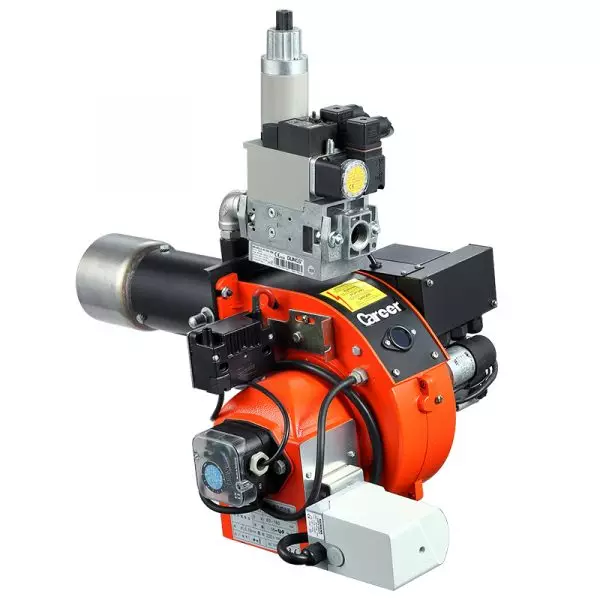
Matching a new burner to existing heating equipment is not simply a matter of finding the same rated capacity. A replacement burner must work within the heater’s combustion chamber, fuel supply, air system, mounting arrangement, and control sequence. If any of those interfaces are overlooked, a burner that appears suitable on paper may perform poorly after installation.
The practical objective is therefore to match the burner to the complete operating conditions of the existing heater. The following steps outline what information should be checked and how the selection can be narrowed before an order is placed.
What Existing Equipment Information Should Be Collected First?
The starting point is the heating equipment, not the burner catalog. Its type, rated heat demand, normal operating temperature, fuel currently used, combustion-chamber dimensions, and existing burner arrangement establish the conditions a replacement must satisfy.
Operating history is equally useful. Production records can show whether the heater normally runs near maximum load or spends substantial time at reduced firing rates. That distinction affects the required burner control range and can be more important than the nominal maximum output.
Physical information should also be documented. Mounting dimensions, burner insertion depth, furnace or boiler opening, available installation space, and access for maintenance all need to be compared with the proposed burner.
Career Burner’s published gas-fired range covers 50–7000 kW and includes different configurations such as modulating, automatic, compact, and heavy-duty gas burners. The range demonstrates why equipment requirements should be established before choosing a particular model.
How Should Burner Capacity Be Matched to Heater Demand?
The correct capacity is the range that can satisfy the heater’s actual thermal requirements, not merely the largest output available from a burner. Maximum firing rate should cover the equipment’s peak demand, while minimum firing rate should remain appropriate for low-load operation.
A burner that is substantially oversized can create an operating mismatch if the heater cannot effectively absorb its minimum output. Excessive cycling may then become a practical concern. An undersized unit creates the opposite problem: the equipment may struggle to reach or maintain its required process temperature.
Load behavior should therefore be examined alongside the heater’s rated input. A gas burner manufacturer can use this information to determine whether the application calls for fixed firing, staged operation, or modulation.
Career Burner lists single-stage, two-stage, and fully modulating gas burner configurations. The appropriate arrangement depends on how the existing heating equipment handles changes in thermal demand rather than on burner capacity alone.
How Can Mechanical and Flame Compatibility Be Verified?
A burner must physically connect to the heater and produce a flame suitable for its combustion space. Checking only the mounting flange is insufficient because combustion-head position, flame geometry, chamber dimensions, and refractory configuration can influence the resulting combustion behavior.
For retrofit work, the burner’s insertion length and head position should be compared with the existing opening. The available chamber space must accommodate the flame without creating an unsuitable impingement or heat-distribution condition.
Application type also matters. A boiler, furnace, oven, or process heater can impose different requirements on flame delivery and heat distribution. Career Burner identifies gas burners for applications including boilers and heating equipment, while its product range includes multiple burner configurations intended for different operating requirements.
Photographs, dimensional drawings, and existing burner information can make this compatibility assessment considerably more precise before installation begins.
How Should Fuel, Air, and Controls Be Matched?
Fuel compatibility should be confirmed first, including the gas type and the supply conditions available at the installation. Career Burner states that its gas-fired burners can operate with common gases such as natural gas and LPG, while particular applications may involve other process gases.
Gas pressure and available flow must still be adequate for the selected firing range. The combustion-air system also needs sufficient capacity and pressure. A burner cannot be evaluated independently from the utilities that support combustion.
Control integration is another decisive interface. The existing heater may already have temperature regulation, ignition sequencing, flame supervision, safety interlocks, and burner modulation. The replacement burner must either communicate with those controls or be incorporated into an appropriately engineered control arrangement.
For this reason, commercial gas burner manufacturers should receive the heater’s control information before recommending a retrofit model. A nominally compatible burner may still require changes to the control architecture.
What Must Be Confirmed Before the Burner Is Commissioned?
Final matching is completed through commissioning rather than paperwork alone. After installation, the burner should be checked across the operating range for reliable ignition, stable flame behavior, correct modulation or staging, and appropriate interaction with the heater’s temperature-control system.
Combustion adjustment is particularly important because the installed environment determines how the burner ultimately operates. Fuel-air settings, chamber conditions, draft, and operating load can all affect combustion results. The selected burner should therefore be commissioned as part of the complete heating system.
A gas burner manufacturer should have sufficient application information to evaluate these interfaces before final selection. Career Burner provides customized combustion solutions for specific applications, making application data useful when a standard catalog configuration does not directly match the existing installation.
The matching decision can ultimately be reduced to five questions: Can the burner supply the required thermal range? Can it physically and combustively fit the heater? Is the available fuel and combustion air suitable? Can its controls integrate with the existing system? Can the complete installation be commissioned reliably?
A burner is a reasonable retrofit candidate when all five criteria are satisfied; any uncertainty should be resolved before purchase rather than through the installation itself. This method gives buyers a more defensible basis for comparing suppliers and helps ensure that the replacement burner functions as part of the existing heating system, not merely beside it.
