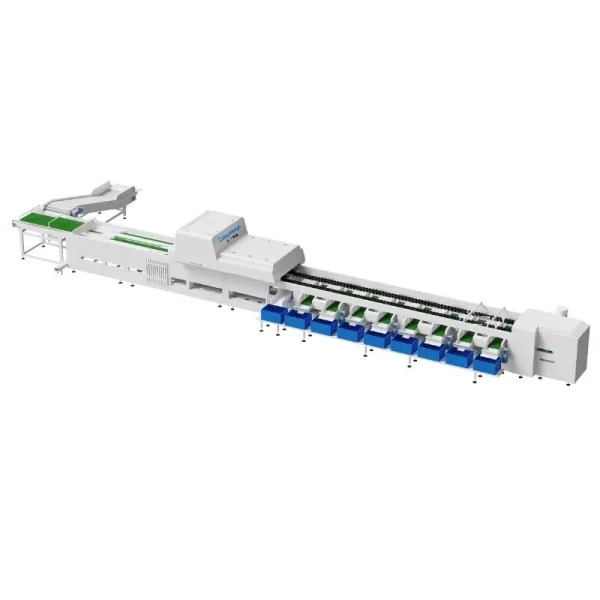
A sorting machine and a checkweigher can both use product weight as part of an automated production process, but they do not necessarily serve the same purpose. The distinction becomes important when a manufacturer is deciding whether products simply need to be verified or actively divided into different weight categories.
The easiest way to understand the difference is to look at the decision made after weighing. A checkweigher generally determines whether an individual product falls within an acceptable weight range. A sorting machine can use weight differences to classify products into predefined groups.
The Decision Each Machine Makes
Weight measurement is only the starting point. What happens after the measurement determines the role of the equipment in the production line.
A checkweigher evaluates a product against a specified weight target or tolerance. Products that meet the requirement can continue, while those outside the permitted range can be identified or rejected. Its primary purpose is therefore verification.
A sorting machine takes a different approach when production requires products to be separated according to weight. Instead of treating weight only as an acceptable-or-unacceptable condition, the system can assign products to different categories.
For example, a processor handling products with naturally varying weights may need to divide them into several weight grades. In that situation, the objective is not simply to remove products outside a tolerance. The objective is to organize the output into defined groups.
When the Goal Is to Verify Every Finished Pack
Checkweighing is particularly relevant after filling, sealing, or portioning because the manufacturer needs to confirm the weight of finished units.
Imagine a packaged food line producing individual retail packs. Each package is expected to contain a specified quantity. A weighing system positioned within the conveyor flow can assess products automatically instead of requiring operators to remove individual packs for manual weighing.
Products falling below or above the configured limits can then be separated from accepted products. The result is an automated verification step incorporated into normal production movement.
This distinction matters because a checkweigher does not need to create multiple product grades. Its decision can be relatively simple: does this individual unit meet the defined weight requirement?
The approach is useful when consistency and conformity of finished packs are the primary objectives. It also allows production personnel to monitor weight variation without manually checking every unit.
When Weight Becomes a Sorting Rule
Sorting becomes more relevant when variation in product weight is not necessarily a defect. Some food products naturally differ in size or mass, and those differences may need to be organized rather than eliminated.
A weight-based grading system can assign products to different categories according to predefined weight ranges. Easyweigh’s weight grader product category is designed around this type of weight-based classification. Easyweigh weight grader solutions
Consider a processing operation where products need to be grouped into several commercial grades. A product that falls into one weight range may need to travel toward one outlet, while another weight range is directed elsewhere.
Here, the machine’s value comes from distribution. The system converts measured weight into a sorting decision, allowing products with different characteristics to follow different production paths.
That is fundamentally different from simply identifying an underweight package. The acceptable output may contain several categories rather than one accepted group and one rejected group.
Why Similar Equipment Can Serve Different Production Goals
The two machine types can appear similar because both may involve conveyors, weighing technology, sensors, controls, and automatic product handling. Their physical appearance alone does not always reveal the operational difference.
The key question is what the production line needs to do with the measurement.
If the requirement is to confirm that a finished product remains within a specified range, checkweighing is the more direct concept. If the requirement is to divide products into several weight classes, a grading or sorting system is more appropriate.
Production objectives can also change over time. A processor may initially need basic weight verification but later introduce multiple product grades. In that case, the equipment specification should be reconsidered around the new workflow rather than assuming that all weighing systems perform identical functions.
The number of required output categories is another useful indicator. One acceptance range points toward verification, while multiple weight destinations point toward classification.
Which Machine Fits the Production Requirement?
Selecting between the two starts with the intended output rather than the machine label.
A manufacturer should first ask whether products outside a target range need to be removed or whether products across several weight ranges need to be distributed. The answer establishes the fundamental function required from the equipment.
Product characteristics then become relevant. Weight range, product dimensions, shape, surface condition, production speed, and conveying behavior can influence the suitable configuration.
The downstream layout also deserves attention. A sorting operation may require multiple product destinations, whereas a checkweighing line may only need a defined path for accepted products and a separate route for nonconforming units.
Easyweigh’s weight grader solutions demonstrate how weight can be used as a classification criterion rather than solely as a pass-or-fail inspection parameter.
Choosing Between Verification and Classification
The difference between a sorting machine and a checkweigher becomes much clearer once the production decision is defined.
A checkweigher answers a verification question: Does this product meet the required weight range? A weight-based sorting system answers a classification question: Which weight category should this product enter?
That difference affects the downstream conveyor arrangement, product destinations, control logic, and overall production workflow. Neither function is automatically better; each addresses a different operational requirement.
For manufacturers evaluating automated weighing equipment, defining the desired output before selecting the machine provides a more reliable starting point. Easyweigh provides equipment focused on automated weighing and weight grading, allowing the appropriate system to be matched to whether the production goal is verification, classification, or a more specific weighing workflow.
