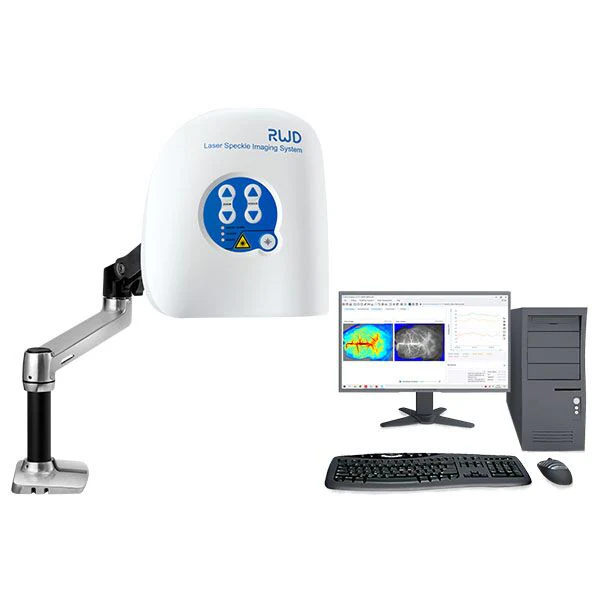
Coherent light interacting with biological surfaces produces a unique visual phenomenon known as a random interference pattern. When a surface like skin or exposed tissue is illuminated by the RFLSI-ZW laser speckle contrast imaging lsci system, the backscattered light waves overlap. This interaction creates a grainy, salt-and-pepper texture consisting of bright and dark spots. These spots are the result of constructive and destructive interference, where the phase differences of the light waves determine the intensity of each pixel. This raw visual data serves as the foundation for the laser speckle contrast imaging lsci technology used by BPLabLine to monitor physiological changes.
The Granular Appearance of Interference
The visual appearance of a laser speckle contrast imaging lsci pattern is characterized by its high-contrast, stochastic nature. In a static medium, these speckles appear fixed and sharp, providing a detailed map of the surface topology at a microscopic level. BPLabLine utilizes a high-resolution CMOS camera in their laser speckle contrast imaging lsci system to capture these fine details with an optical resolution of up to 3.9 μm/pixel. Because the light source is a stable 785 nm laser, the resulting speckle grains are clearly defined, allowing for precise mathematical analysis of the variance within the intensity distribution.
Motion and the Blurring Effect
Dynamics within the tissue, such as the movement of red blood cells, alter the visual state of the speckles. When particles move, the interference pattern fluctuates rapidly, causing the speckles to appear blurred during the camera’s integration time. This blurring is a critical component of the laser speckle contrast imaging lsci system, as it directly correlates with the speed of blood flow. Higher velocity results in a more significant loss of contrast, turning the sharp granular texture into a smoother, more uniform gray appearance in the raw frames.
Visualization Through Color Mapping
While the raw laser speckle contrast imaging lsci data is monochrome, they process these signals into intuitive blood perfusion maps. The laser speckle contrast imaging lsci system converts the degree of blurring into a pseudo-color scale, typically ranging from blue for low perfusion to red for high flow. This transformation allows researchers to see microvascular networks and hemodynamic changes in real-time at up to 100 frames per second. By analyzing the standard deviation of pixel intensity, they provide a visual representation of microcirculation that is otherwise invisible to the naked eye.To conclude, the visual nature of laser speckle begins as a complex interference pattern and ends as a data-rich perfusion map. The laser speckle contrast imaging lsci system by BPLabLine ensures that every fluctuation is captured accurately, providing a scientific window into the movement of fluids within living tissue without the nee
